
Middlemarch drew me into the minds of others, both within and beyond the book. By revealing the full complexity of others’ lives, the novel teaches us to recognise that the world is sustained by countless acts of care.
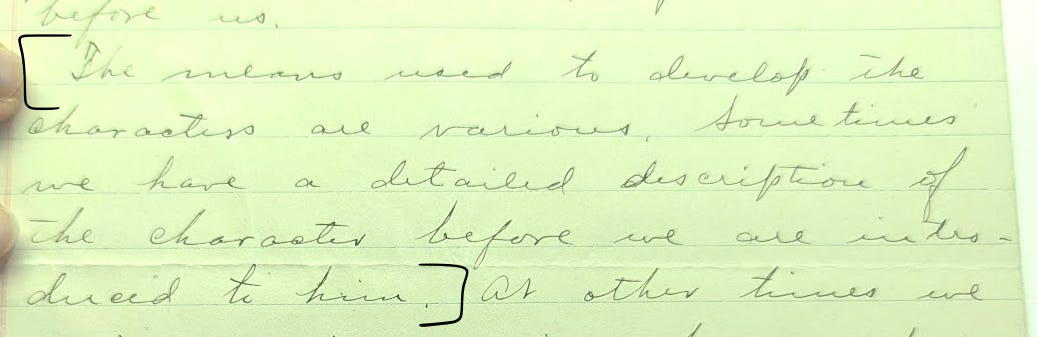
It began when I was working through Wilson Library’s Eliot collection while close reading Middlemarch, where I discovered an excerpt from a DiPhi speech Samuel Watson Reaves wrote in 1898. He was a math student at UNC Chapel Hill, reading the same texts as I was--Middlemarch, and likely also a differential equation textbook.
Reading his speech felt less like encountering a historical artifact and more like overhearing a parallel consciousness. It made me realise that what Middlemarch offers is not just a story but a way of seeing into the minds of others. In fact, Reaves discussed a theme strikingly similar to one I wrote about before (it was about Lydgate’s introduction into the town’s happenings, I’m withholding specifics because spoilers). Two readers, separated by 127 years and sharing little beyond Middlemarch and UNC, arrived at the same insight.
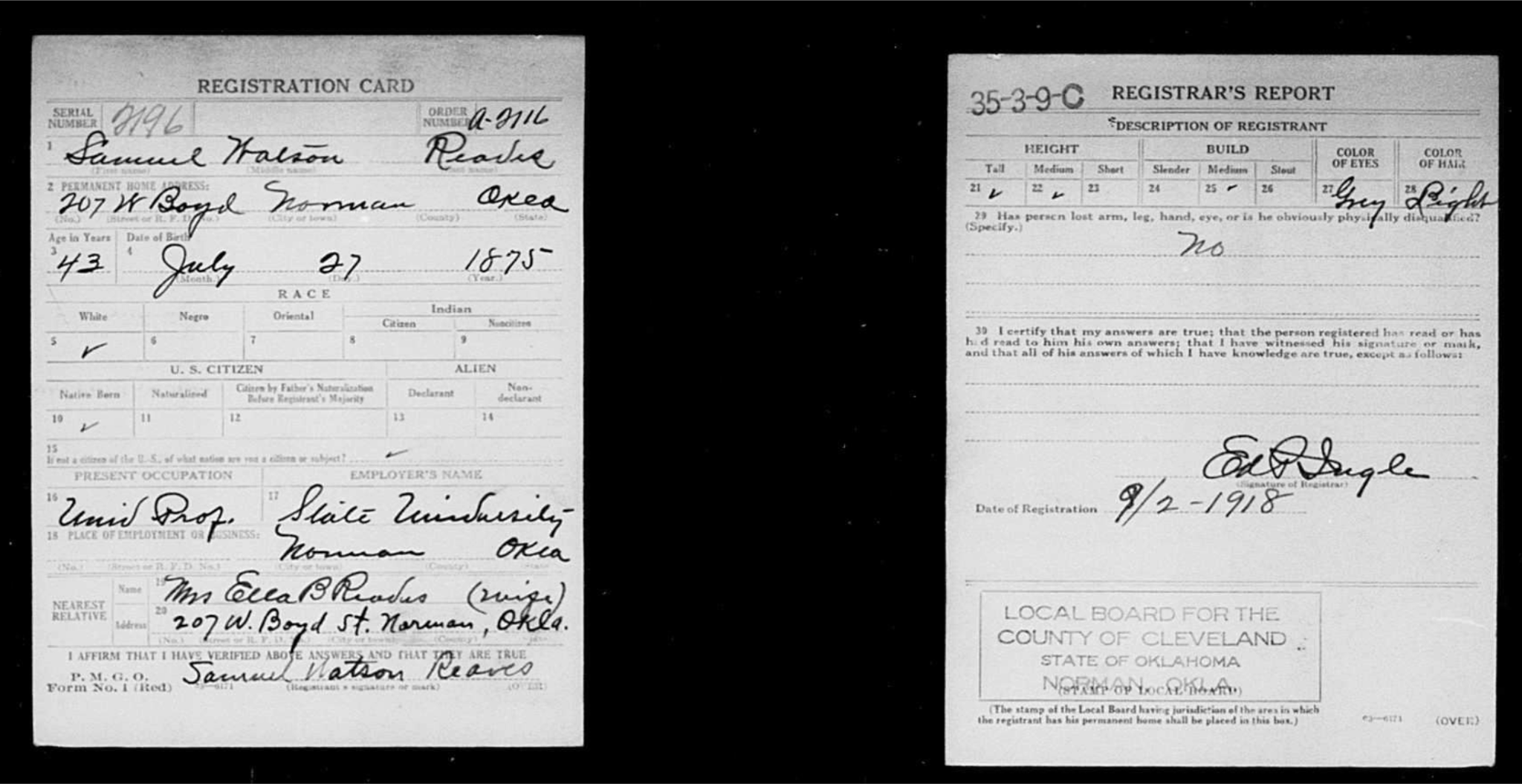
After some sleuthing I found his World War I registration card. He was born in 1875 and Eliot died in 1880, making him just the second generation of readers who encountered her work.
Reaves himself had a story worthy of Eliot’s novels. He was born in South Carolina and went on to climb the ranks at UNC, the University of Chicago, the University of Oklahoma and Cornell. Just like Lydgate, a young doctor who arrives at Middlemarch wanting to change its medical institution, Reaves moved to a small town in Oklahoma and embedded himself in an institutional structure for mathematics. His research specialization is unspecified in my sources, but he clearly excelled at it as he rose from being a Professor of Mathematics to the Dean of Arts and Sciences. He married after a long courtship, unexpectedly adopted an infant son, but devastatingly lost both of them in World War II within just a week of each other. Like Eliot’s characters, Reaves lived a life shaped by forces larger than himself: war, personal loss, institutional bureaucracy and religion.
The book drew me into the perspectives of its characters, as their lives unfolded with deliberate slowness over several chapters. Within its pages, it distilled something that can hardly be described in words--the sense of growing alongside characters whose emotional lives are only created and sustained in the minds of the readers! I would describe this experience as Eliot wanting to give us a masterclass in moral attentiveness--the discipline of understanding that every life is dense with its own motives, constraints, illusions and hopes.
“If we had a keen vision and feeling of all ordinary human life, it would be like hearing the grass grow and the squirrel’s heart beat, and we should die of that roar which lies on the other side of silence.” Chapter 20
Eliot so skillfully reframes what it means to notice. She does this by refusing to let us settle for quick judgements. Dorothea could easily remain only an idealist, Rosamond only vain and Lydgate only proud. Eliot slows each of them down and reveals the fears, illusions and pressures beneath their outward behavior. Her insistence is that complexity is always there, whether we choose to see it or not. And she doesn’t merely describe this to us. She makes us feel it. And feel I did, as I audibly gasped and sat in silence with my heart racing, when Rosamond and Ladislaw scandalously held hands in Book Eight. 1
“We are all of us born in moral stupidity, taking the world as an udder to feed our supreme selves.“ Chapter 21
The same attentiveness Eliot demands of her readers is required to understand any complex system. What Reaves and I experienced while reading Middlemarch--the gradual training of perception--extends beyond literature into the way we interpret the rest of the world. I saw this happen to me while taking a stroll in the Wikipedia page of global GDPs.
The world runs on a lot of quiet, unglamorous infrastructure that most people never think about: the security guards outside drug factories in Hyderabad, a flock of new grads designing seed coatings in Germany, the process engineer overseeing chlorine production in China, loading and unloading container ships owned by Greek families, Egyptian workers operating toll booths on the Suez Canal. Individually they are easy to dismiss, but together they hold up the systems we depend on. I can’t picture the scale of effort it takes to keep so many invisible industries running. Like Eliot’s description of human life, the complexity is overwhelming if we try to perceive it all at once. 2
Despite this, the world largely functions. It holds together. And it is because of people like our Dorothea who make this happen. How could we ever argue that her role doesn’t quietly hold up more than we are able to comprehend as readers? I think Eliot herself believes this too.
“But the effect of her being on those around her was incalculably diffusive: for the growing good of the world is partly dependent on unhistoric acts; and that things are not so ill with you and me as they might have been, is half owing to the number who lived faithfully a hidden life, and rest in unvisited tombs.” FINALE
I am a semi frequent adrenaline junkie. So this is genuinely surprising
How very pin factory of me